
FRP (fibre reinforced polymer) is plastic reinforced with glass fibres: the fibres carry the load, and polyester or vinyl ester resin holds them in place and protects them from water and chemicals. FRP contains no iron, so an FRP purlin cannot rust. FRP is also called GRP or fibreglass composite.
Glass fibre: the load-bearing part
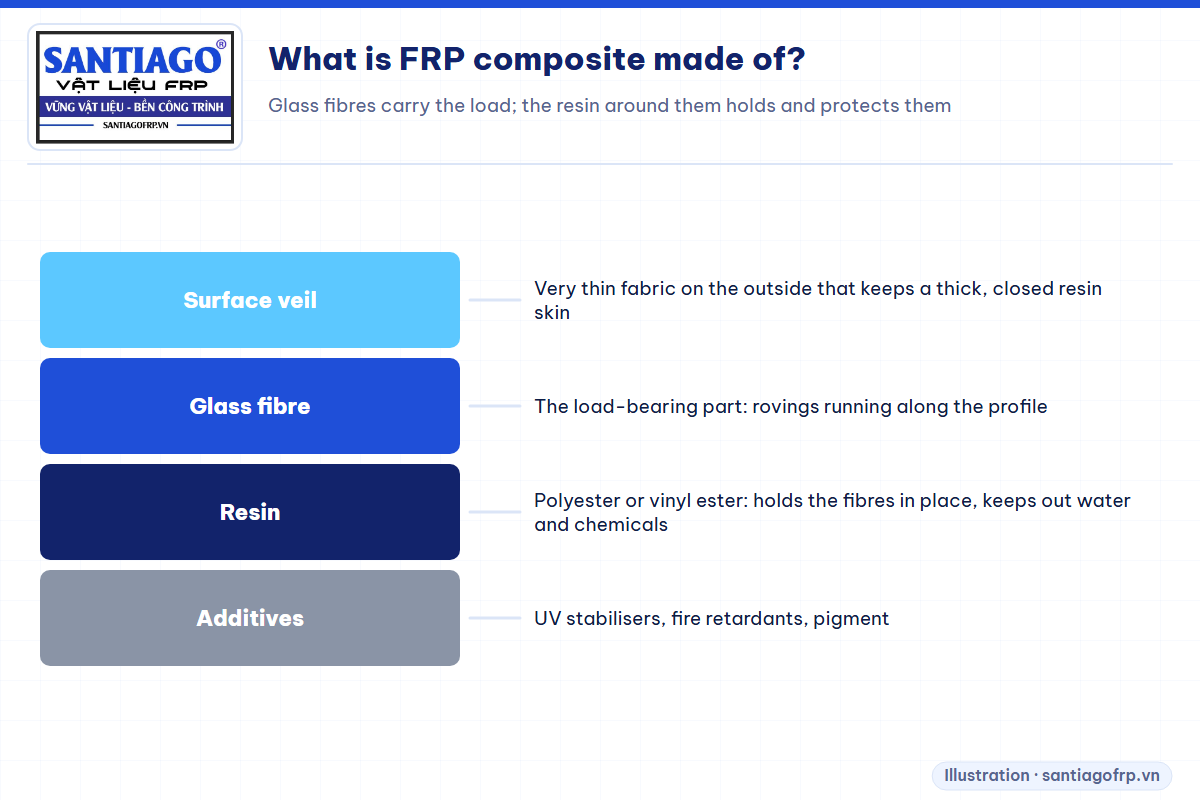
Purlins use E-glass, the most common and economical reinforcing fibre. Thousands of filaments thinner than a hair are bundled into rovings that run straight along the whole length of a pultruded profile. Mats of random or woven fibre near the surface help the profile resist transverse forces and stop it splitting along the fibres. Fibre is usually more than half of the profile's weight.
Resin: the protective part
Polyester is the most common resin. Where chemicals are strong, such as plating shops or wastewater plants, vinyl ester is used because it resists acids and alkalis better. Additives are mixed in as needed: UV stabilisers for outdoor use, fire retardants where fire rules apply, and pigments. Many profiles also have a thin surface veil that keeps a thick, closed resin layer on the outside.
How are FRP profiles pultruded?
- Hundreds of roving reels feed fibres at the same time.
- The fibres pass through a resin bath.
- Guides arrange fibres and mats into the cross-section, for example a 100 × 50 mm box.
- A heated steel die cures the resin, so a rigid profile comes out.
- A puller draws the profile continuously and a saw cuts it to length.

Because the fibres run lengthwise, a pultruded profile is very strong along its length but much weaker across it. That suits purlins, which bend along their length, and it is why bolts through the box need a sleeve inside and must not be overtightened.
Why doesn't FRP rust?
Rust is iron oxidising in water and oxygen; salt, ammonia and acid fumes speed it up. FRP has no iron, so there is nothing to rust. Not rusting does not mean resisting everything: polyester handles salt water, ammonia, dilute acids and most farm disinfectants, while concentrated alkalis, hydrofluoric acid, strong solvents or hot chemicals need vinyl ester and a special surface barrier.

How does FRP compare with steel, aluminium and timber?
| Property | Pultruded FRP | Structural steel | Aluminium | Timber |
|---|---|---|---|---|
| Density (t/m³) | 1.9 – 2.1 | 7.85 | 2.7 | 0.5 – 0.9 |
| Elastic modulus (GPa) | 20 – 25 | about 200 | about 70 | 8 – 14 |
| Rust, rot | No | Rusts | Corrodes in alkalis, salt | Rots, termites |
| Conducts electricity | No | Yes | Yes | No when dry |
| Conducts heat | Poorly | Well | Very well | Poorly |
Two rows matter most. FRP weighs about a quarter of steel for the same volume; a 6 m SF-100 purlin weighs about 11.7 kg. FRP is about eight to ten times less stiff than steel, although its tensile strength along the fibres is similar to ordinary structural steel. So FRP purlins rarely break on normal roofs but sag if undersized, which is why they are chosen by deflection and are taller than steel boxes for the same span.

What else should I know?
- FRP does not conduct electricity, so it is safer than steel near power lines or switchboards.
- It conducts heat poorly and does not get burning hot in the sun like steel.
- FRP is a plastic and can burn; where fire rules apply, use a fire-retardant resin.
- After many years of direct sun the surface may fade and roughen; UV additives and a surface veil slow this down.
- It can be cut and drilled with normal tools fitted with carbide or diamond blades; wear a mask and gloves because glass fibre dust itches.
More: how long FRP lasts outdoors.
Frequently asked questions
What does FRP stand for?
FRP stands for fibre reinforced polymer. The FRP used for purlins is polyester or vinyl ester resin reinforced with glass fibre, also called GRP or fibreglass composite.
Does FRP composite rust?
No. Rust is oxidised iron, and FRP contains only glass fibre and resin, so ammonia, salt air or dilute acids cannot make it rust.
How heavy is FRP compared with steel?
Pultruded FRP has a density of about 1.9 – 2.1 t/m³ against 7.85 t/m³ for steel, so for the same volume FRP weighs about a quarter as much.
Is FRP as stiff as steel?
No. Its elastic modulus is about 20 – 25 GPa against about 200 GPa for steel, so FRP purlins are sized by deflection.