
Roofs commonly use three kinds of purlin: galvanised steel (C, Z or box), timber and FRP composite. None is best for every roof. The right choice depends on the air under the roof, how long the building must last and whether the owner accepts repairing the roof after a few years.
Timber purlins
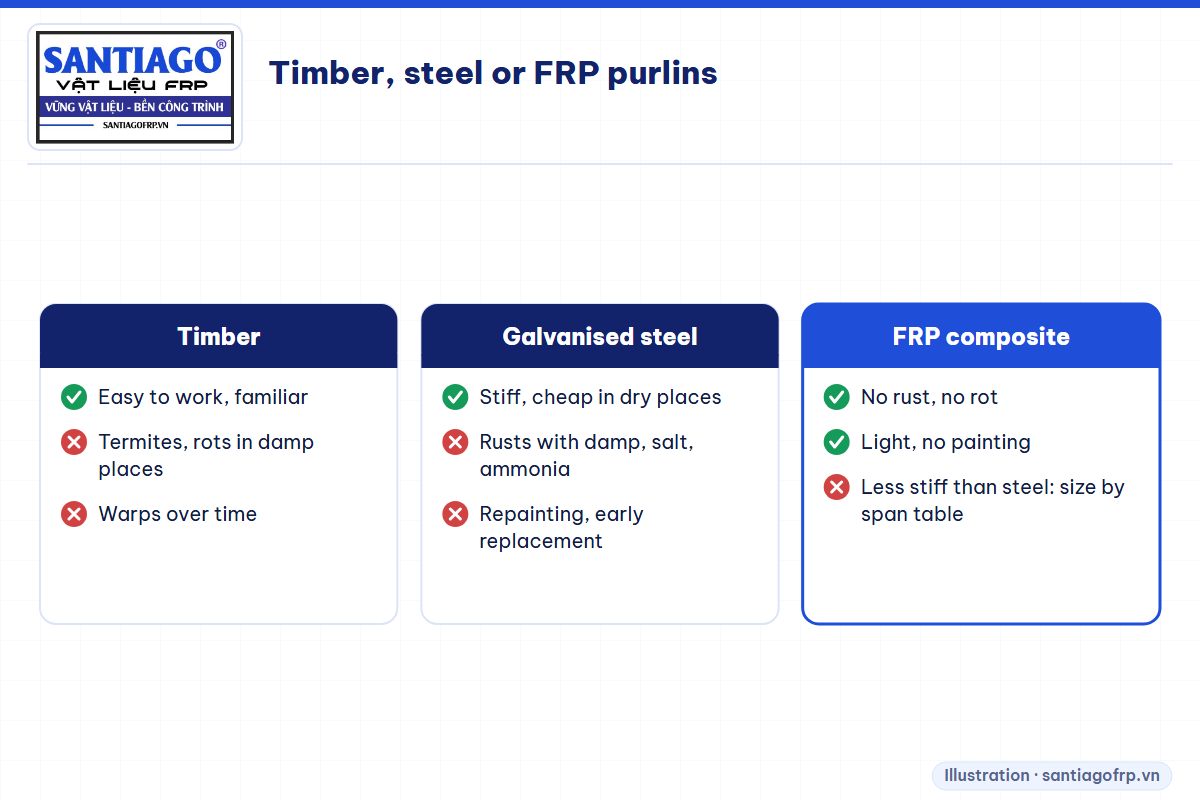
Timber is easy to find in the countryside, carpenters know it and small quantities are cheap. Its weaknesses are termites, rot in damp places, warping and splitting. Good timber lasts but is increasingly expensive; cheap timber needs treatment and still rots at the ends. Timber suits small, dry buildings whose owners are ready to replace it.
Galvanised steel purlins
Steel purlins come as C, Z or box sections, 1.5 – 3 mm thick, galvanised or zinc-aluminium coated. Steel is very stiff, cheap per metre and sold everywhere, and dry town houses use it well. Its weakness is rust: the zinc only protects until it is consumed. In livestock sheds, coastal areas and chemical plants the zinc goes many times faster, and drilled and screwed points rust first because the coating was damaged during installation.
FRP composite purlins
FRP does not rust, rot or attract termites, needs no painting and does not conduct electricity. It weighs about a quarter of steel for the same volume. On the other hand, FRP is eight to ten times less stiff than steel, so for the same rafter spacing an FRP purlin must be taller. The price per metre is usually higher than galvanised steel, and FRP can burn; where fire rules apply, use a fire-retardant grade.
Weight: an example
A steel C purlin 100 × 50 × 20 mm, 2 mm thick, weighs about 3.5 kg/m. The FRP SF-100, a 100 × 50 mm box with 3.5 mm walls, weighs 1.95 kg/m, almost half, despite thicker walls. The two are not equally stiff, so a fair comparison uses sizes that span the same rafter spacing, usually one FRP size up. Even then the FRP purlin is lighter and easier to lift.

Comparison table
| Criterion | Timber | Galvanised steel | FRP composite |
|---|---|---|---|
| Rust, rot | Rots, termites | Rusts, fast with ammonia, salt, chemicals | No rust, no rot |
| Weight | Light | Heaviest | About 1/4 of steel by volume |
| Stiffness | Medium | Stiffest | Less stiff, sized by deflection |
| Installation | Easy to saw | Cutting machine, screws or welding | Carbide blade, bolts, cannot be welded |
| Maintenance | Termite treatment, replace when rotten | Repaint in wet or chemical air | No painting |
| Conducts electricity | No | Yes | No |
| Fire | Burns | Does not burn but loses strength when hot | Can burn; fire-retardant grades exist |
| Price per metre | Depends on wood | Low | Higher than steel |
Cost over the life of the roof
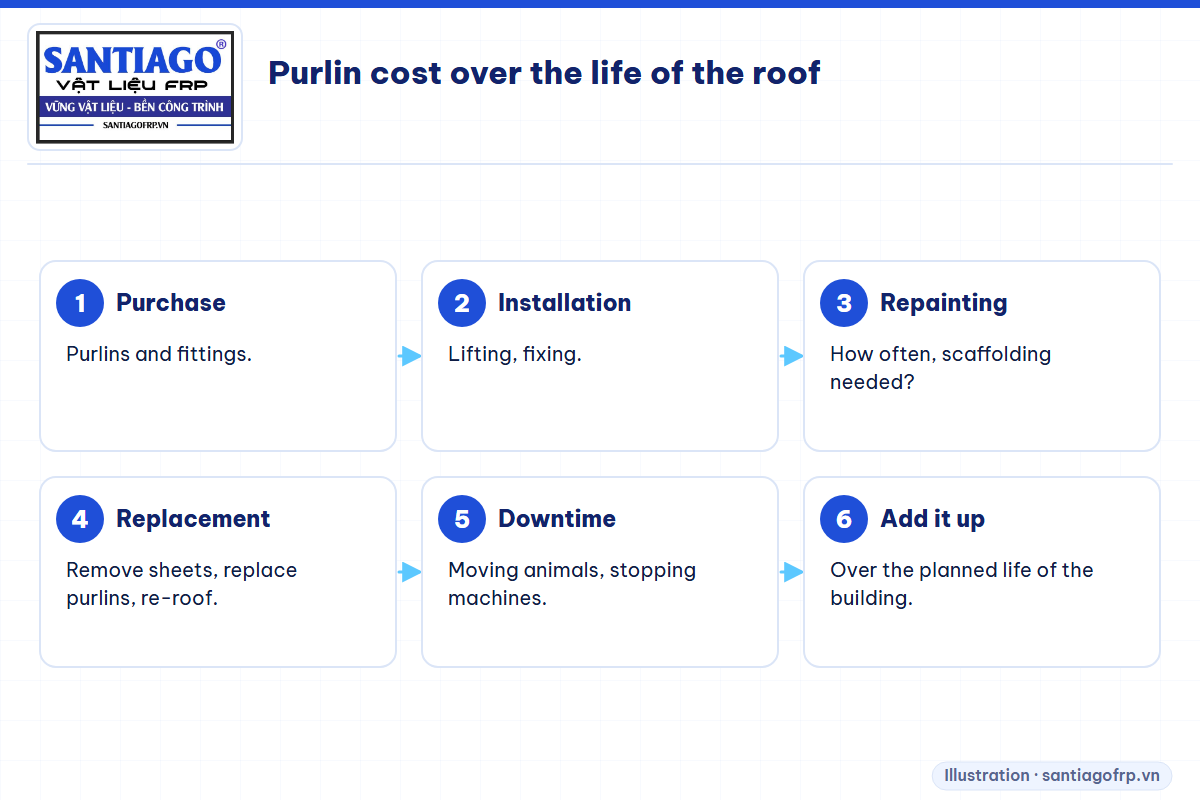
Comparing price per metre is only fair if both last equally long. Add up purchase, installation, repainting (how often, how much, scaffolding), replacement (removing and refixing sheets) and losses from stopping a farm or factory. In pig farms, seaside buildings and chemical plants, steel may need repainting several times and replacing at least once during the building's life, so FRP is often cheaper overall. In dry town houses, steel remains cheaper.
Which should I use for my building?
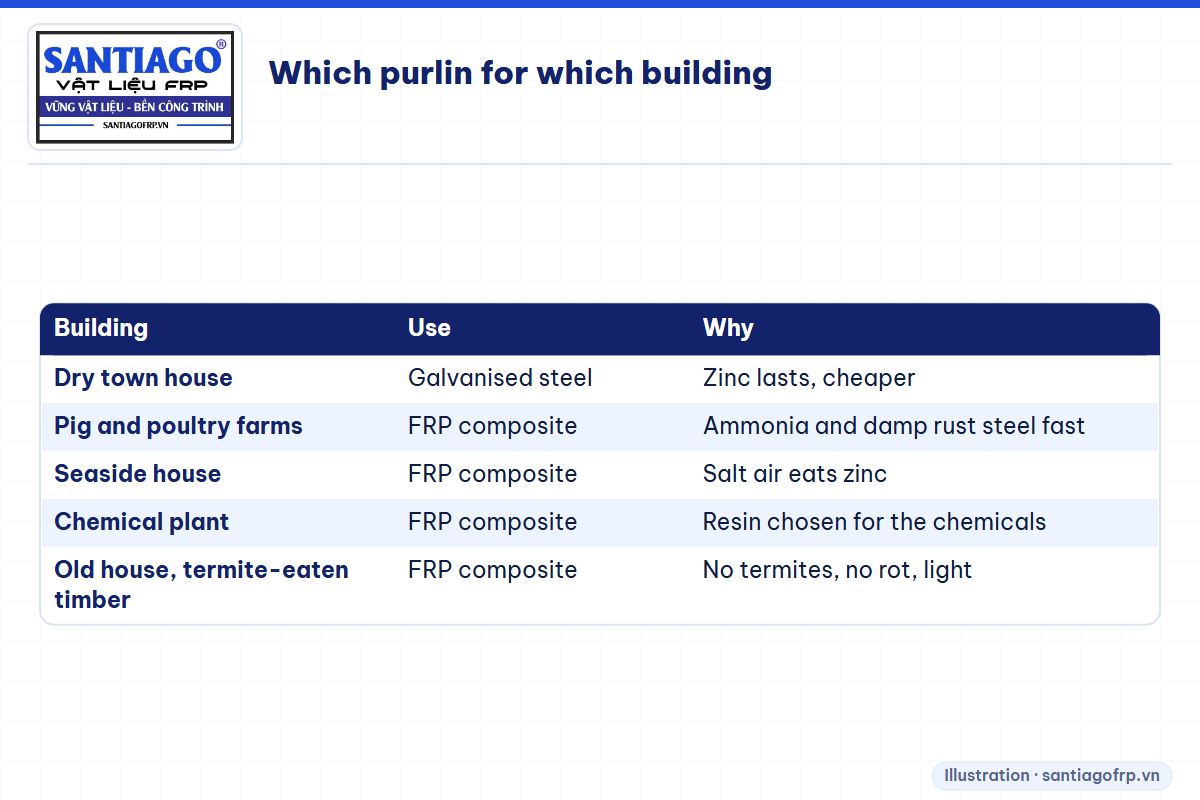
- Poultry, pig and cattle farms: FRP.
- Seaside houses, shrimp ponds, fish stores: FRP.
- Plating shops, fertiliser stores, wastewater plants: FRP, vinyl ester grade for strong chemicals.
- Old houses with rotten timber purlins: FRP if the space is damp or houses animals, steel if dry.
- Dry houses and ordinary stores: galvanised steel.
- Huts and temporary roofs: timber or steel.
Frequently asked questions
Are FRP purlins more expensive than steel purlins?
The price per metre is usually higher than galvanised steel. In farms, coastal buildings and chemical plants, where steel must be repainted and replaced early, the total cost over the roof's life is often lower with FRP.
Should an ordinary house use FRP purlins?
A dry town house is fine with galvanised steel purlins. FRP is worth it where steel rusts fast: livestock sheds, coastal sites, shrimp ponds and chemical plants.
How much lighter is an FRP purlin than a steel one?
For the same volume, FRP weighs about a quarter of steel. A 2 mm steel C100 × 50 × 20 weighs about 3.5 kg/m, while the FRP SF-100 weighs 1.95 kg/m.