
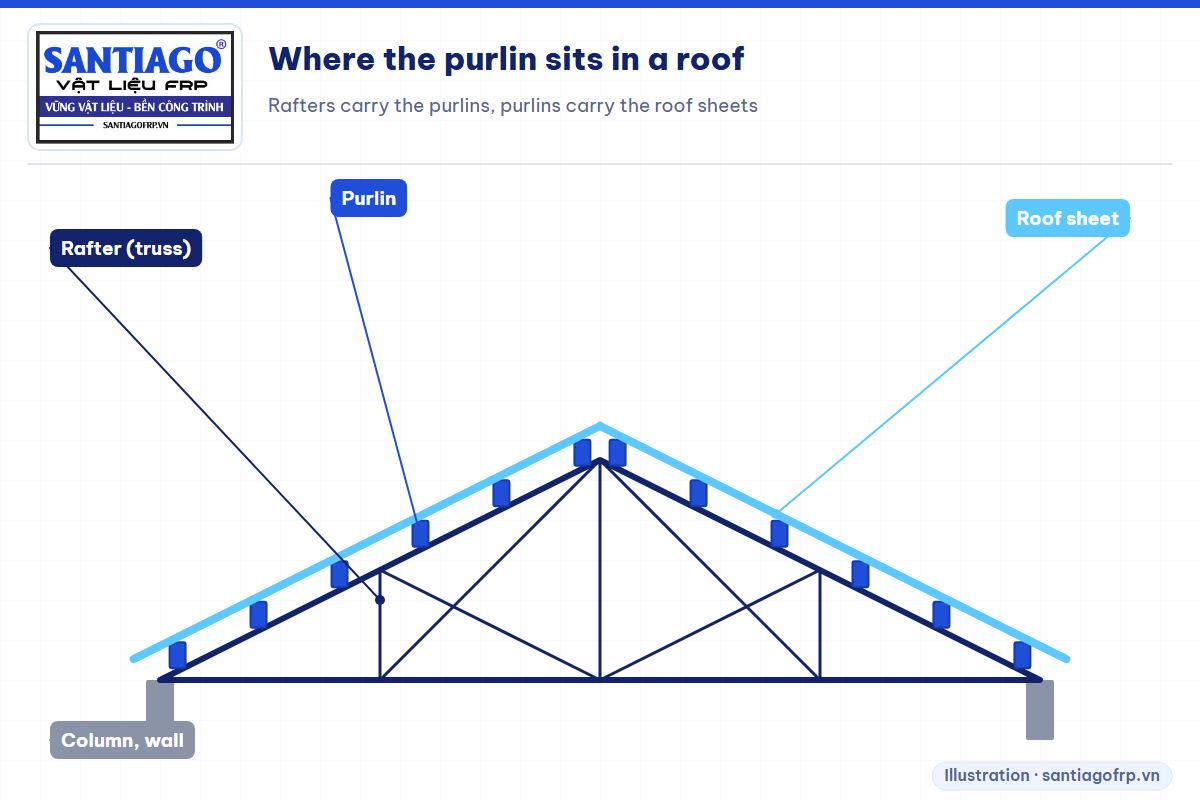
A purlin is a horizontal member that sits on the rafters and supports the roof sheets. An FRP composite purlin is made of glass fibre reinforced polymer instead of steel or timber, so it does not rust or rot. Santiago FRP purlins are rectangular hollow boxes in six sizes, SF-60 to SF-220.
Where does the purlin sit in a roof?
Most sheet or plastic-tile roofs have three layers. Rafters (or trusses) are the main frame, spaced along the building. Purlins run across the rafters along the length of the building. Roof sheets are screwed to the purlins. The distance between two rafters is the rafter spacing; the distance between two purlin rows, measured along the slope, is the purlin spacing. These two numbers decide the purlin size.
Why is the FRP purlin a box?
- A closed box resists twisting far better than an open C section; on a sloping roof, the sheets pull sideways and a C section twists.
- FRP is less stiff than steel, so it needs the stiffest possible shape for the material used; a box standing upright is very stiff in bending.
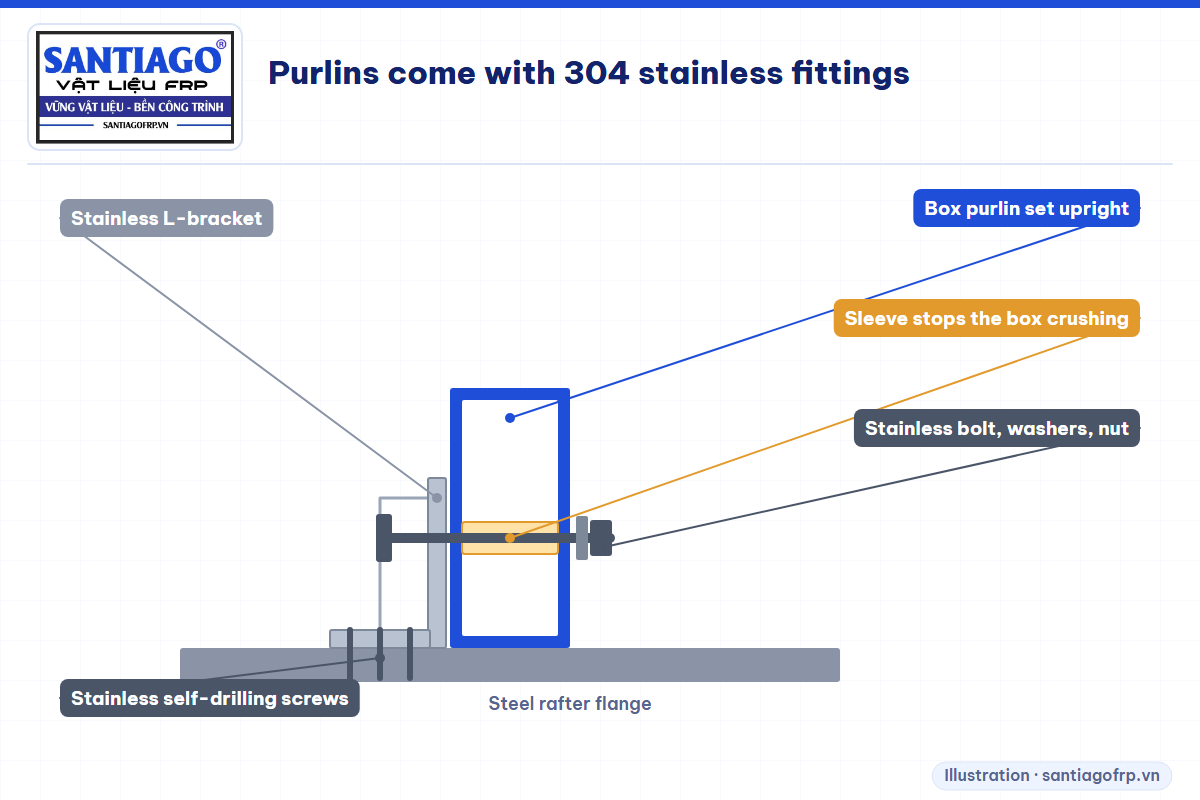
- Bolts pass through both walls with a sleeve inside, so the joint is strong and the box is not crushed.
- The flat top is easy to screw roof sheets into.
The box is always installed upright, long side vertical. Laid flat, it is several times less stiff and will sag.

The six SF sizes
| Code | Box (mm) | Cells | Weight (kg/m) | 6 m length | Typical use |
|---|---|---|---|---|---|
| SF-60 | 60 × 30 × 3 | 1 | 0.98 | about 5.9 kg | Verandas, small houses, rafters 1.2 – 1.5 m |
| SF-80 | 80 × 40 × 3 | 1 | 1.33 | about 8 kg | Houses, small stores, rafters 1.5 – 2 m |
| SF-100 | 100 × 50 × 3.5 | 1 | 1.95 | about 11.7 kg | Poultry and pig farms, rafters 2.5 – 3 m |
| SF-120 | 120 × 60 × 3.5 | 1 | 2.36 | about 14.2 kg | Farms, greenhouses, rafters 3 – 4 m |
| SF-160 | 160 × 55 × 4 | 2 | 3.60 | about 21.6 kg | Factories, frames 4 – 5 m |
| SF-220 | 220 × 55 × 4 | 2 | 4.53 | about 27 kg | Large factories, frames 5 – 6.5 m |
The right size for a roof depends on the rafter spacing and the design wind pressure; spans for each size are in FRP purlin sizes.

What is supplied with the purlins?
A rust-free purlin fixed with ordinary steel bolts still fails at the joints. Santiago FRP supplies each size with 304 stainless fittings: L-brackets, bolts, nuts, washers, anti-crush sleeves, self-drilling screws for steel rafters and end caps. Purlins are cut to length and pre-drilled at the rafters, so no cutting is needed on the roof.
Where is an FRP purlin worth using?
FRP purlins pay off where steel purlins fail quickly: livestock farms with ammonia, coastal buildings with salt air, shrimp ponds, fish stores, humid greenhouses, plating shops, fertiliser stores and wastewater plants. See livestock farm roofs, coastal roofs and chemical plant roofs.
Where is it not needed, or needs a separate check?
- Dry houses in town: galvanised steel purlins are cheaper and work well.
- Heavy roofs such as concrete or clay tiles.
- Roofs carrying solar panels, fans or lighting rigs hung from the purlins.
- Rafter spacing above 6.5 m.
- Near strong heat sources such as dryers or chimneys.
Frequently asked questions
What is an FRP composite purlin?
A box-section purlin made of glass fibre reinforced polymer. It sits on the rafters, supports the roof sheets and does not rust or rot.
How many sizes does Santiago FRP offer?
Six: SF-60, SF-80, SF-100 and SF-120 are single-cell boxes; SF-160 and SF-220 are double-cell boxes. The number is the box height in millimetres.
Why are FRP purlins boxes and not C sections?
A closed box resists twisting better than an open C and is stiffer in bending for the same material, which matters because FRP is less stiff than steel.
Should an FRP purlin be installed upright or flat?
Upright, with the long side vertical. Laid flat it is several times less stiff and will sag.