
A coastal roof lasts longest when purlins, bolts and sheets are all rust-free: FRP purlins, stainless fixings and plastic sheets or tiles. Salt air rusts steel purlins from the gap between sheet and purlin, so many seaside buildings replace their steel purlins after a few years.
How far inland does salt air reach?
Airborne salt is heaviest in the first few hundred metres from the shore and falls off inland. Under ISO 9223, seafront buildings are usually corrosivity category C4 to C5, sometimes worse right by the surf. In monsoon winds and storms salt is carried further inland, so buildings several kilometres from the sea can still be affected.

Where do coastal steel purlins fail first?
Salt particles get into the gap between the sheet and the purlin, where sun and wind cannot dry them and rain cannot wash them away. The zinc is eaten from there, then at the screw holes. From outside the roof looks fine while the purlins underneath are rusted through, and in storms roofs tear off from exactly these points.

How do I build a coastal roof that lasts?
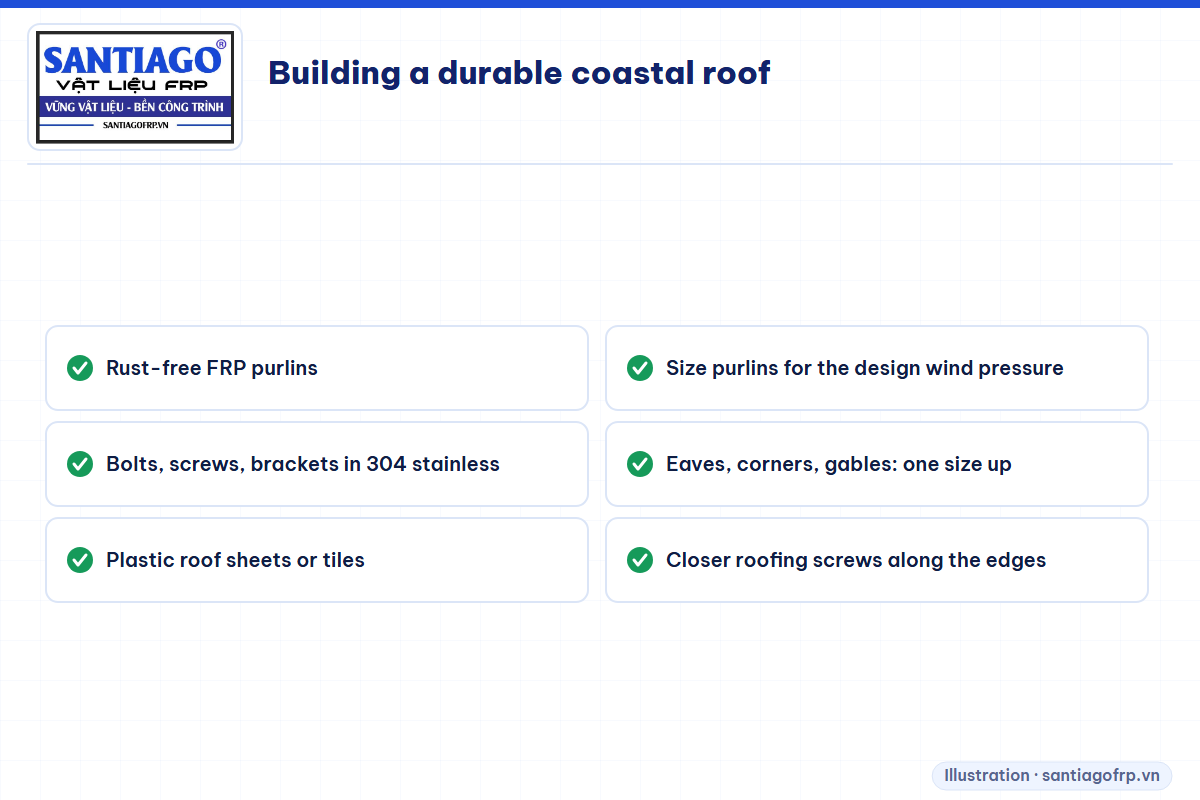
- FRP purlins: no metal, so salt cannot rust them.
- 304 stainless bolts, screws and brackets.
- Rust-free sheets: plastic roof sheets or plastic tiles.
- Purlin size chosen for the design wind pressure; coasts often have the highest wind pressures.
- One size larger and closer screws along eaves, corners and gables.
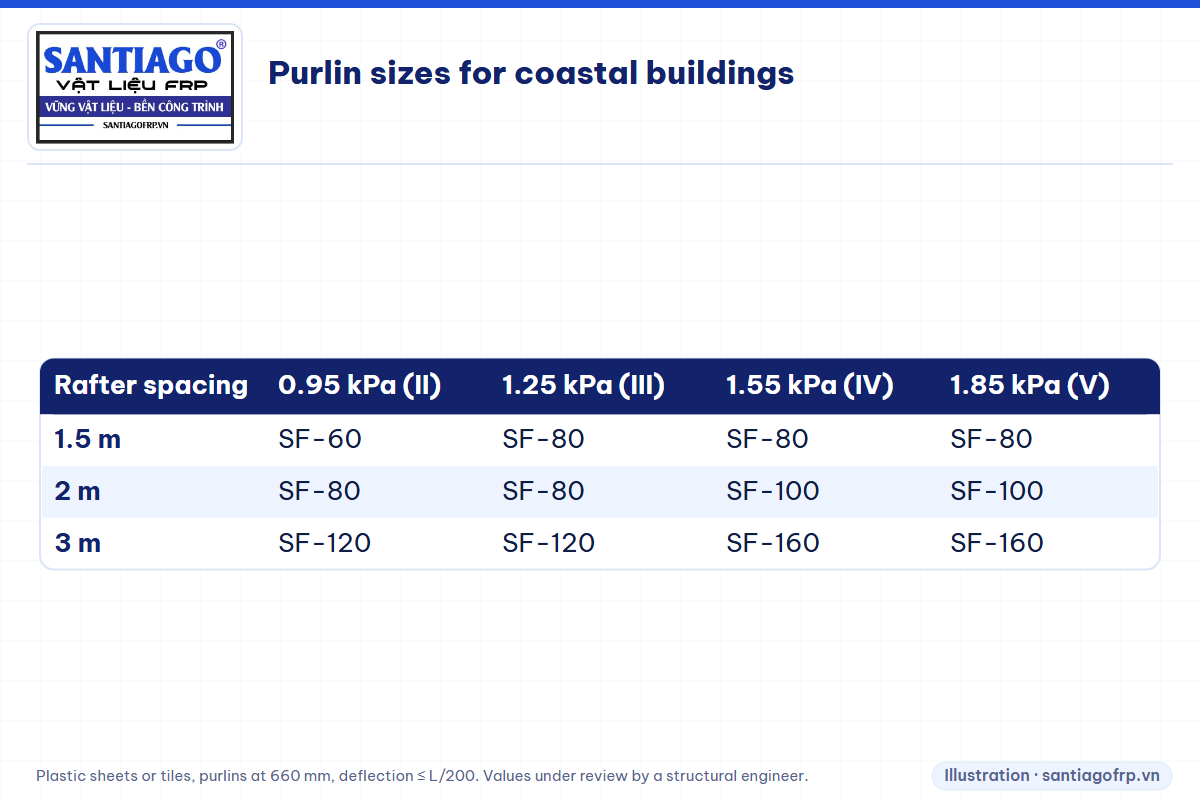
Which FRP purlin size for a coastal building?
| Rafter spacing | 0.95 kPa (II) | 1.25 kPa (III) | 1.55 kPa (IV) | 1.85 kPa (V) |
|---|---|---|---|---|
| 1.5 m | SF-60 | SF-80 | SF-80 | SF-80 |
| 2 m | SF-80 | SF-80 | SF-100 | SF-100 |
| 3 m | SF-120 | SF-120 | SF-160 | SF-160 |
For plastic roof sheets with purlins at 660 mm. Seaside houses and verandas usually have rafters 1.2 – 2 m apart; fish stores and shrimp-pond net houses often 3 m. Sizes: SF-80, SF-100, SF-120.
Shrimp ponds, fish stores and beyond the roof
Shrimp-pond net houses are both humid and salty, so steel frames rust very fast; fish stores have melting ice and spilled salt. FRP purlins with stainless bolts save replacing the frame every few seasons. For the same reason, outdoor stairs, platforms and walkways on the coast are better in FRP: FRP grating and FRP stairs.
Frequently asked questions
Why do coastal roofs rust so fast?
Sea wind carries salt onto purlins and sheets. Night dew dissolves it into a thin salty film that rusts steel quickly, especially in the gap between sheet and purlin, which never dries and is never rinsed by rain.
Which purlins should a seaside building use?
FRP composite purlins, which contain no metal and cannot rust in salt air, with stainless bolts and screws and rust-free sheets such as plastic roof sheets or tiles.
How far from the sea is salt air a problem?
It is heaviest in the first few hundred metres from the shore and decreases inland. In monsoon winds and storms, salt can be carried several kilometres inland.